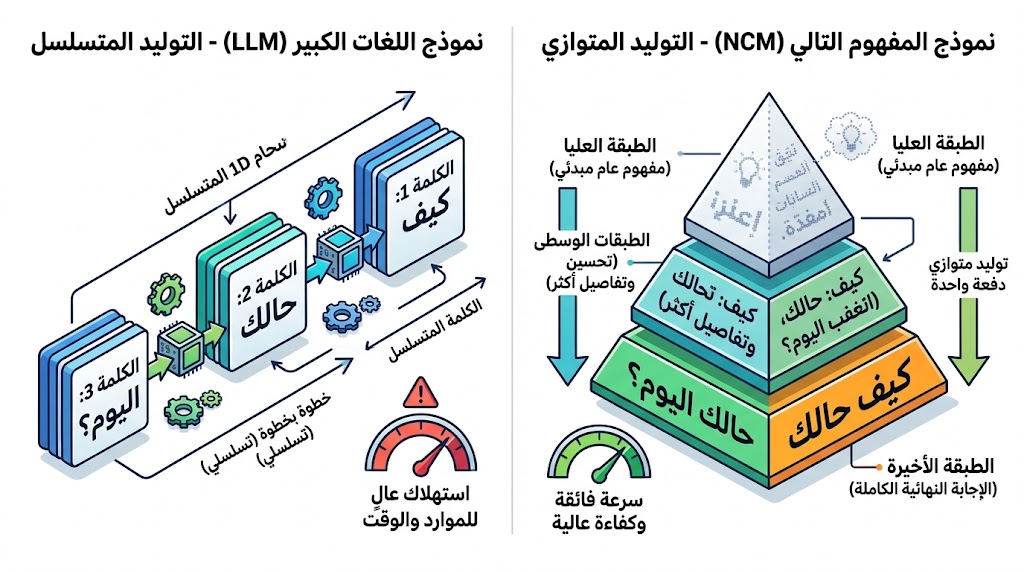
Overview: What is Next-Concept Modeling (NCM)?
NCM is a text-generation framework developed by Stanford’s Hazy Research and Together AI, and published on arXiv on October 9, 2026. Unlike traditional token-by-token generation, NCM builds text from coarse structure to fine detail. In experiments, NCM matched or surpassed strong diffusion-language models while delivering 10–31× faster generation and training on roughly 4–5× fewer tokens.
Benchmarks and What They Measure
The headline figures often cited compare speed, token efficiency, and model quality. NCM’s reported gains depend on how the generation task is framed—from broad outlines to detailed prose—and on the token budget used for training. For technology leaders, these metrics matter when evaluating cost, latency, and user experience in AI-powered applications.
Comparison with Today’s LLMs
While LLMs optimize for broad coverage and fluent text, NCM emphasizes structured generation at multiple levels of abstraction. This can lead to faster responses and reduced compute at inference time, especially in scenarios that benefit from predictable structure—such as summaries, reports, or code-like outputs—where the final text adheres to a predefined schema.
Implications for Tech, FinTech, and Capital Markets
- Cost and latency reductions: Lower token consumption and faster generation can reduce operating costs for AI-enabled services.
- Deterministic outputs: Structured generation may enhance consistency, which is valuable for compliance, reporting, and automated decision workflows.
- Product design considerations: Teams may design prompts and interfaces that leverage coarse-to-fine generation to meet strict output formats.
- Evaluation framework: Benchmarks should assess not only natural language fluency but adherence to schema, accuracy, and auditability.
Practical Takeaways
For product and engineering teams, NCM represents a complementary approach to LLMs. It may be advantageous to combine NCM-based components with traditional LLMs to balance creativity, structure, and speed depending on the use case.
Conclusion
As AI models evolve, understanding the trade-offs between structure-first generation (NCM) and token-by-token modeling (LLMs) is essential for building scalable, cost-efficient AI systems. The choice between approaches should align with application requirements, performance targets, and regulatory constraints.
Sources
Original article: edenai.co/post/ncm-vs-llm-next-concept-modeling